
Choosing a Custom Jewelry Manufacturer for a First Collection
A first collection usually fails on sequencing rather than design. When a factory can return 3D CAD in under 48 hours, a new brand gets two days to correct a silhouette before anyone cuts a mould, and the published 25–30 day sampling window is where most of the calendar really goes. The order of decisions matters more than the length of the supplier list.
Key takeaways
- Five designs in 925 sterling silver commit 250 pieces at 50 per design; the same five in eco-brass commit 500 at 100 per design.
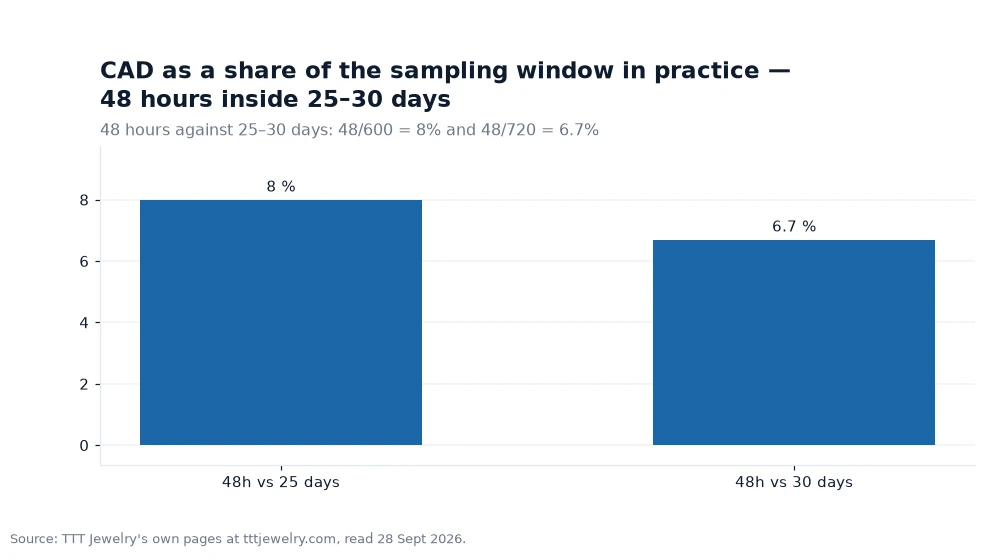
- CAD arrives in under 48 hours, which is 2 days, or 6.7–8% of a 25–30 day sampling window.
- The published route from CAD to dispatch totals 48–60 days, roughly 7–9 weeks, if every approval lands on schedule.
- 100% inspection means every unit is checked, and a 100% NDA keeps moulds, CAD files and the collection away from other brands.
Two quotations for the same ring can differ by six weeks and still both be honest. The difference is usually what each supplier counts as the start of the job. One begins the clock when the deposit clears; another begins it when the buyer approves a drawing. Ask every candidate to write the four windows down in the same order: modelling, sampling, bulk production, final inspection and dispatch. Then ask who owns each handover.
A factory that has run OEM and ODM work since 2010 tends to answer in operations rather than adjectives. TTT Jewelry, for instance, publishes a six-step flow that names inquiry, consultation, CAD and prototype, sample approval, bulk production, and final QC and delivery. The last step is described as 100% inspected, which is a statement about coverage, not a promise about outcomes. That distinction is worth more to a first-time buyer than any showroom tour.
Put the answers in a single column and the shortlist often sorts itself. A supplier who cannot separate sampling from production will blur the two in the quote as well, and the blur usually hides a longer promise than the one printed.
What the published calendar actually tells you
The useful numbers are narrow enough to test. A reliable jewelry OEM factory will state what happens inside each window, not only how long the window is. Sampling is the clearest example: 25–30 days is long enough for wax printing, casting, stone setting, polishing and electroplating in sequence, and short enough that a supplier skipping one of those steps will quote ten days and call it speed.
| Stage | Published window | What a first-time buyer locks in |
|---|---|---|
| CAD and prototype | Under 48 hours | Silhouette, dimensions and stone placement |
| Master sampling | 25–30 days | Finish, plating colour and wear feel |
| Bulk production | 3–4 weeks | Quantity, packing sequence and dispatch date |
| Final QC and delivery | 100% inspected | Units cleared for retail, not a sample batch |
| Day-to-day contact | 24-hour response, one project manager | How fast a question becomes a decision |
Notice that only one row is about manufacturing speed. The other four are about how quickly information moves. A first collection is small enough that a single unanswered email can cost a week, which is why the 24-hour response and the named project manager belong in the same table as the mould.
Sampling is the expensive place to be vague
The sample is the only physical contract a buyer gets before volume. Treat the approval as a measurement exercise: record the inner diameter, band width, total weight, stone seat depth and clasp tension, then keep the signed sheet with the photographs. Colour needs its own line, checked in daylight rather than under a desk lamp, because 14K, 18K and 24K gold tones read differently against skin and against a white card.
Feedback rounds are where first collections slip. The 25–30 days covers the factory's sequence; it does not cover the week a buyer spends circulating a sample among friends. Decide in advance who signs, what counts as a minor correction, and whether a second sample is needed. A change to stone size after casting is a new mould conversation, and the calendar restarts from a later point than most founders expect.
Ask, too, where the sample is made. A piece built on the same bench and plated in the same bath as bulk production tells you something a hand-finished prototype cannot. The eight-step factory sequence published by TTT Jewelry runs from concept drawing through sprue cutting, polishing, surface art and electroplating to final QC, and a sample that has passed through those stages is a fair preview of the run.
Minimums decide the shape of collection one
Minimum order quantities multiply by design, not by order. At 50 pieces per design for 925 sterling silver and 100 per design for artisan eco-brass, a four-design debut costs 200 silver units or 400 brass units. The silver line therefore carries half the unit commitment of brass per design, which is the opposite of what most founders assume about the more expensive metal.
That single ratio should drive the first range. If the plan is to test six shapes and reorder the two that sell, brass at 100 per design spreads the bet across more SKUs for the same money as a tighter silver range. If the plan is a small, edited offer with a higher retail price, silver at 50 per design keeps the stock position lighter. Stainless steel sits at 100+ per design and earns its place when the product has to survive showers and swimming, since 316L with 2–3% molybdenum is the grade built for that use.
Material also changes the finish conversation. Multi-layer gold plating over custom brass jewelry needs an anti-tarnish e-coating on the base metal, while stainless steel takes PVD vacuum plating and sterling silver takes rhodium or gold over a protective coat. Choosing the metal after the mood board is how a first collection ends up with a plating spec that cannot be repeated at volume.
The paperwork that protects a first order
Exclusivity is a production term, not a legal flourish. A 100% NDA should mean the mould, the CAD file and the collection itself are not resold or shown to another brand, and the buyer should be able to say where those files live when the project closes. Ask for that sentence in the quotation rather than in a general brochure.
Compliance has a similarly narrow vocabulary. ISO 9001:2015 describes a quality management system applied across production stages; BSCI covers labour and social audit; REACH restricts lead, cadmium and nickel, and the plating is stated as compliant with REACH and California Proposition 65. A first-time buyer does not need to audit the factory, but should be able to match each certificate to a document with a scope and a date.
Hallmarks belong on the drawing. S925, 316L and 18KGP are laser-engraved marks, and their position, depth and size are settled in CAD, not after polishing. A supplier who treats the stamp as a packaging detail will produce a beautiful piece with the mark where the clasp rubs it away.
Worked example
Take the published route at its two ends. Fast case: 48 hours of CAD is 2 days, sampling at 25 days, production at 21 days, so 2 + 25 + 21 = 48 days. Slow case: 30 days of sampling and 28 days of production give 2 + 30 + 28 = 60 days. The spread is 48–60 days, or roughly 7–9 weeks, before transit. CAD is a small slice of that: 48 hours inside a 25-day window is 48/600 = 8%, and inside a 30-day window it is 48/720 = 6.7%. A brand that spends nine days reviewing the CAD file has added more calendar than the modelling itself took, which is why the review deadline, not the modelling speed, is the number to police.
Frequently asked questions
How many designs should a first collection include?
Four to six designs is a practical range because each design carries its own minimum: 50 pieces in 925 sterling silver, 100 in eco-brass, 100+ in stainless steel. Six brass designs therefore commit 600 units, while six silver designs commit 300.
Can a first order be produced without a physical sample?
It can be attempted, but the 25–30 day sampling stage exists to catch fit, finish and plating colour before tooling is committed. Skipping it moves risk from the factory calendar to the sell-through rate.
What should be agreed before CAD modelling starts?
Metal, plating colour, stone list, hallmark placement and packaging format. CAD takes under 48 hours, so a brief that arrives complete is the fastest acceleration available to a new brand.
Building a shortlist you can defend
Score each candidate on written windows, minimums per design, and the documents behind the compliance claims. Keep the deposit small enough that a failed sample is survivable, and put the approval deadline in the same document as the sampling date. Brands comparing the two development models can read the OEM/ODM jewelry manufacturer page before the first call, because the difference between building to a buyer's CAD and developing a concept changes who owns the calendar.
Source note: figures come from the manufacturer's own website (tttjewelry.com), read 28 Sept 2026.[1]