
A drugstore fragrance launch is scheduled backwards from a shelf date, not forwards from a purchase order, and almost every late launch is caused by a stage that was left to run in sequence when it could have run in parallel. The two stages that most often get compressed are testing and artwork, because both depend on decisions made earlier and neither can be finished in a hurry. A supplier visit belongs near the front of the calendar, while the brief is still being written, because the output of a visit is better questions rather than a signed document. Treating the visit as early, cheap time is the simplest way to buy back weeks later.
Key takeaways
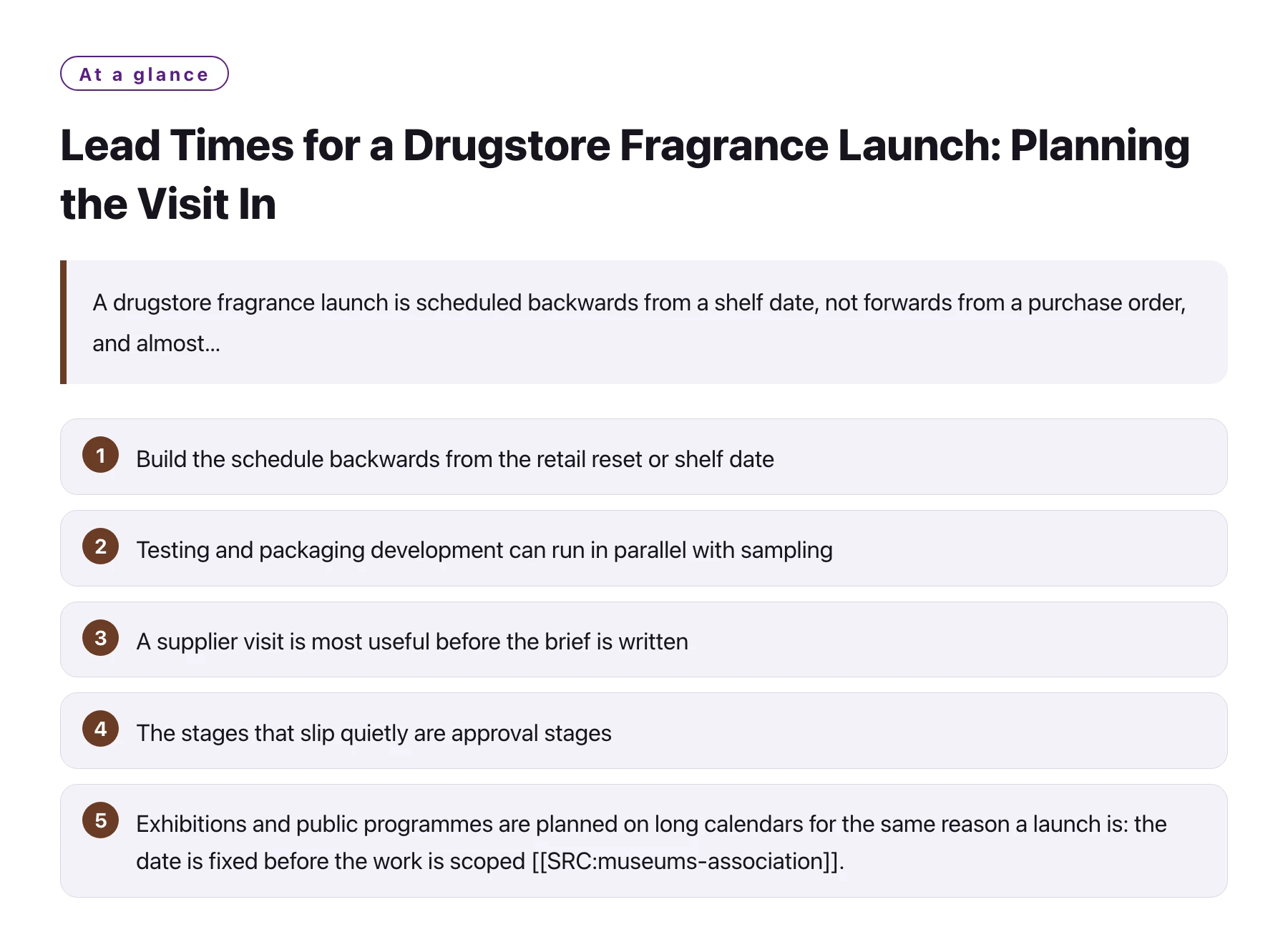
- Build the schedule backwards from the retail reset or shelf date, and put the fixed points in first: artwork approval, stability window, pilot run and shipping.
- Testing and packaging development can run in parallel with sampling, but only if the fill weight and pack format are frozen before they start.
- A supplier visit is most useful before the brief is written, because what a buyer sees on site changes what the brief asks for.
- The stages that slip quietly are approval stages, not production stages, and each approval needs a named person and a deadline.
- Exhibitions and public programmes are planned on long calendars for the same reason a launch is: the date is fixed before the work is scoped [1].
Every launch meeting starts with the same question and answers it in the wrong order. The question is when the range needs to be on shelf; the answer is usually a supplier quotation with a lead time attached. Between those two points sits a sequence that includes sampling, selection, testing, artwork, packaging, a pilot, bulk production and shipping, and the sequence has fixed points that no amount of pressure can move.
The practical fix is to reverse the direction. Put the shelf date at the top of a page, then work backwards through the fixed points: the date goods must leave the factory, the date bulk production must start, the date the pilot must be approved, the date artwork and packaging must be signed off, the date the final sample must be approved, and the date by which the brief has to be stable enough to sample against. What remains above the line is the time available for exploration, and that is where a visit can be fitted in usefully.
Planning this way makes one thing obvious: the early weeks are the cheapest weeks to spend. Reading a supplier's assumptions about sequence and lead times on its official website its official website before the first call costs an afternoon and can remove a whole sample round, because it changes what the brief asks for and what the buyer asks the supplier to commit to.
Why the schedule is built backwards
Developed forward, a plan reads as a list of things to do and hides the dependencies. Developed backward, it exposes them. Artwork cannot be finalised until the fill weight, the bottle and the mandatory labelling statements are settled. Bulk production cannot be scheduled until the carton and bottle are in the warehouse or on a confirmed delivery date. Shipping cannot be booked until the goods pass final inspection. Each dependency has a decision behind it, and each decision has a person who owns it.
The benefit of writing the plan this way is that it separates work that takes time from work that takes attention. Sampling takes time because it involves making things and smelling them. Artwork takes attention because it involves several approvals and a print deadline. Confusing the two is how a project ends up with a comfortable sampling period and a panicked last fortnight.
What can safely overlap
Compatibility and stability work can overlap with sampling, provided the fill weight, the product base and the pack format are already frozen; otherwise the testing is run against a moving target. Packaging development can overlap with testing, because bottle and cap lead times are often the longest single item in the plan. Component ordering can overlap with the sample approval round if the buyer is willing to carry the risk of a design change, which is a commercial decision rather than a scheduling one.
What cannot overlap is the chain of approvals that ends in artwork release. Every downstream stage inherits the decisions made there, so compressing those approvals raises the chance of a reprint or a rework rather than the chance of an earlier launch.
Where the visit fits
A visit to a working site is cheap in calendar terms if it happens while the brief is being written, and expensive in calendar terms if it happens after the brief has been issued, because anything learned then has to be absorbed through a change request. Buyers who schedule the visit for week one or two usually get a stronger brief, and a stronger brief is the single most effective lead-time instrument available.
The sequence, in the order it has to happen
- Fix the shelf date and the retail resetWrite the date down before anything else, and confirm it with the category contact rather than assuming it.
- Write the brief against three range positionsThe brief should be specific enough to sample against and open enough to allow more than one interpretation.
- Visit the site while the brief is still openUse the visit to test materials and accords, and to turn observations into written questions and a shortlist.
- Run sample rounds against a named referenceEach round should be evaluated against the brief and the previous reference, with comments recorded rather than remembered.
- Freeze fill weight, pack and label contentThis is the gate that allows testing and packaging work to proceed in parallel without rework.
- Run compatibility and stability work in parallel with packagingBoth take calendar time, and both should finish before the pilot so that failures are still cheap.
- Approve the pilot and the retained referenceThe pilot is the last point at which a problem can be corrected without scrapping finished goods.
- Schedule bulk, final inspection and shippingBook inspection capacity early; it is a common late-stage bottleneck when several projects land together.
Where the calendar actually slips
| Stage | What it depends on | How it slips quietly |
|---|---|---|
| Brief stability | A named owner and a fixed scope | Comments from several stakeholders arrive at different times and reopen settled questions |
| Sample approval | A reference to compare against | Each round is judged on its own rather than against the brief, so the project drifts |
| Compatibility and stability | Frozen fill weight, base and pack | The formula or pack changes mid-way and part of the testing is discarded |
| Artwork and labelling | Final formula data and pack dimensions | The label content is treated as a design task and confirmed late |
| Packaging delivery | Confirmed component specification | Decoration decisions change after tooling, requiring a second pass |
| Final inspection and shipping | Booked inspection slot and freight space | Inspection capacity is assumed rather than reserved for the week that matters |
Every line in that table is an approval or a specification rather than a machine. That is why adding days to production rarely rescues a late launch, while moving a decision forward by a week often does. The museum of scent in Guangzhou the museum of scent in Guangzhou is a useful reminder of the same lesson in another form: an experience is designed in sequence, and the sequence cannot be reversed once visitors are walking through it.
The most reliable way to shorten a launch is to reduce the number of things that are still undecided when the clock starts. A buyer who can hand over a frozen fill weight, a chosen pack and a settled label outline at the same meeting has effectively removed a month of rework. It also helps to know exactly what the supplier will own, because one-stop fragrance manufacturing one-stop fragrance manufacturing only saves calendar time when the scope genuinely sits inside one organisation; a clear description of what one-stop scent development covers what one-stop scent development covers is worth reading before the first scheduling call.
Sources
- Museums Association —— A professional body for museums, publishing guidance and research on museum practice and visitor experience.
Frequently asked questions
How far ahead should a drugstore fragrance launch be planned?
Far enough ahead that sampling, testing, packaging and artwork can each have their own window rather than sharing one. The exact number of weeks depends on the pack, the market and the number of sample rounds, which is why the plan is better built backwards from the shelf date than estimated forwards from a quotation.
Can testing and sampling run at the same time?
Yes, once the fill weight, product base and pack format are frozen. If any of those three is still moving, the testing is being run against a target that will change, and part of the work will have to be repeated.
When should a buyer visit a fragrance supplier?
Early, ideally while the brief is still being written. A visit that happens before the brief changes what the brief asks for, while a visit that happens afterwards can only generate change requests.
What is the most common cause of a late fragrance launch?
Late approvals rather than slow production. Artwork sign-off, label content confirmation and the decision to freeze a specification are the points where projects lose weeks, and each of them needs one named owner with a date.
Does a shorter lead time mean a worse product?
Not necessarily, but it does mean fewer chances to correct a mistake. The stages that are cut first are usually the ones that catch problems, such as stability work and the pilot, so a compressed schedule should be matched with a narrower scope rather than with fewer checks.